For decades, the digital workplace has been a flat, two-dimensional experience. We have been confined to the glowing rectangles of our monitors, navigating through files, applications, and colleagues via icons and tabs. Communication has been reduced to email threads, instant messaging bubbles, and video call grids. While these tools have enabled unprecedented connectivity, they often lack the intuitive, collaborative, and context-rich nature of physical interaction. We are on the brink of a fundamental shift, a move away from computing as a separate activity we do and towards computing as an integrated layer over the world we inhabit. This paradigm is known as Spatial Computing, and it is poised to dismantle the traditional boundaries of the digital workplace, creating an environment that is more human-centric, immersive, and profoundly efficient.
Spatial Computing is not merely a new gadget; it is a foundational change in how we interact with digital information. It encompasses a spectrum of technologies including Augmented Reality (AR), Virtual Reality (VR), Mixed Reality (MR), and the Internet of Things (IoT) that blend the physical and digital worlds. In a spatial computing environment, digital objects are no longer trapped behind a screen. They can be pinned to your physical wall, manipulated with your hands in 3D space, and shared seamlessly with colleagues across the globe as if they were physically present. This article will serve as a comprehensive guide to understanding the spatial computing digital workplace, exploring its core components, transformative applications, tangible benefits, implementation challenges, and the profound future it heralds for how we work, collaborate, and innovate.
A. Deconstructing the Spatial Computing Ecosystem
To fully grasp its impact on the workplace, it’s essential to understand the technological pillars that constitute spatial computing. They are often used interchangeably, but represent distinct points on the “virtuality continuum.”
A. Augmented Reality (AR): The Digital Overlay
AR superimposes digital information such as images, text, or 3D models onto the user’s view of the real world. The key characteristic of AR is that the physical world remains the primary environment. Think of smart glasses that display your meeting notes in the corner of your vision or a smartphone app that lets you see how a new piece of furniture would look in your actual office. In the workplace, AR acts as a contextual information layer, providing data exactly when and where it is needed without forcing the user to look away from their task.
B. Virtual Reality (VR): The Total Immersion
VR creates a completely computer-generated, immersive environment that replaces the user’s physical surroundings. Using a head-mounted display (HMD), users are transported to a virtual space, whether it’s a simulated conference room, a digital twin of a factory floor, or a fantastical landscape for a creative brainstorm. VR is ideal for scenarios where total focus is required or where the physical environment is a limitation, enabling deep collaboration and training without geographical constraints.
C. Mixed Reality (MR): The Seamless Blend
MR sits at the most advanced point on the spectrum, merging the real and virtual worlds to produce new environments and visualizations where physical and digital objects co-exist and interact in real-time. Unlike AR, which simply overlays data, MR allows digital objects to be anchored to and respond to the physical world. You could have a virtual prototype of a car engine on your desk, and you could walk around it, take it apart with your hands, and see how its digital components interact with the light and shadows of your real office. This is the pinnacle of spatial interaction.
D. The Internet of Things (IoT): The Nervous System
While not always grouped with spatial computing, IoT is its critical enabler. IoT refers to the network of physical objects embedded with sensors, software, and other technologies to connect and exchange data with other devices and systems over the internet. In a spatial workplace, IoT sensors provide the real-time data about the physical environment temperature, occupancy, equipment status, inventory levels that can then be visualized and interacted with through AR, VR, or MR interfaces. The IoT is the nervous system that feeds contextual data to the spatial computing brain.
B. Transformative Applications Across Key Business Functions
The theoretical potential of spatial computing is vast, but its real power is revealed in its practical, day-to-day applications that are already being piloted and deployed across various industries.
A. Revolutionizing Collaboration and Remote Work
The hybrid and remote work models have exposed the limitations of video conferencing. “Zoom fatigue” is a real phenomenon, stemming from the cognitive load of interpreting non-verbal cues from a grid of faces and the lack of a shared sense of space. Spatial computing offers a powerful alternative.
-
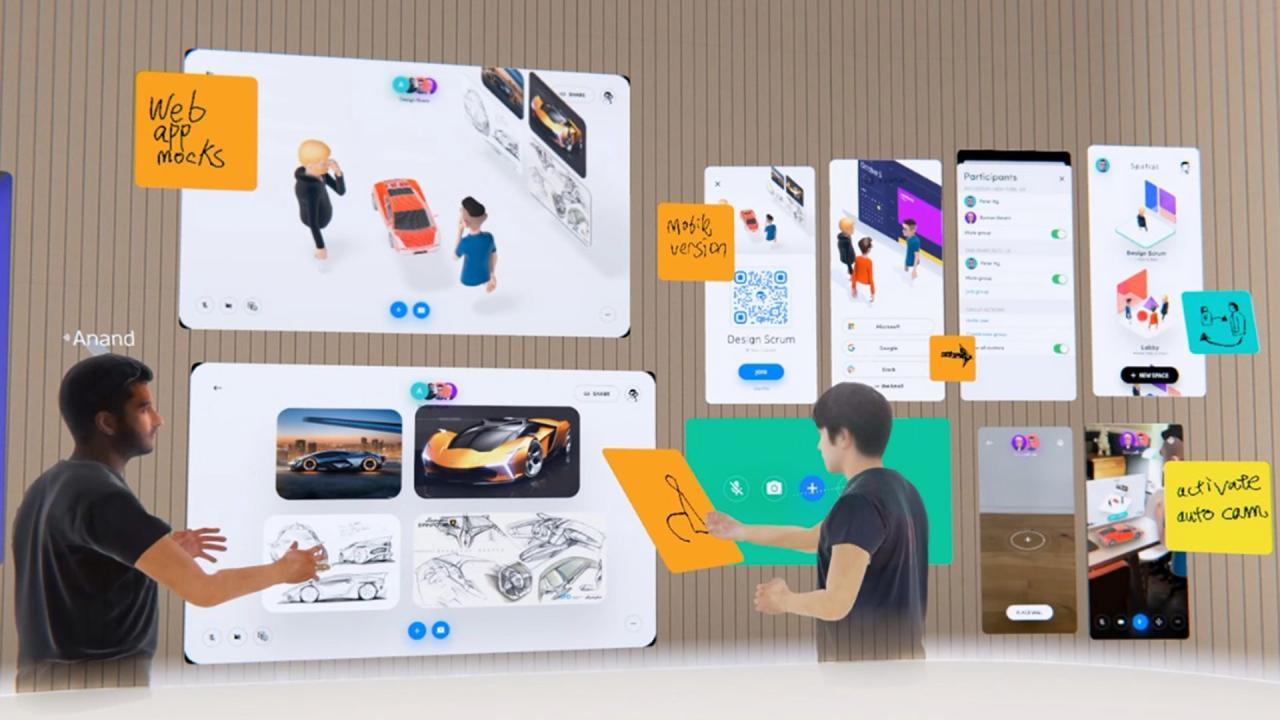
Immersive Meeting Rooms: Instead of a 2D grid, team members from different continents can don VR/MR headsets and join a meeting as lifelike avatars in a virtual boardroom. They can share 3D models, write on virtual whiteboards that feel tangible, and experience the non-verbal cues of turning one’s head or making eye contact, restoring a crucial layer of human interaction.
-
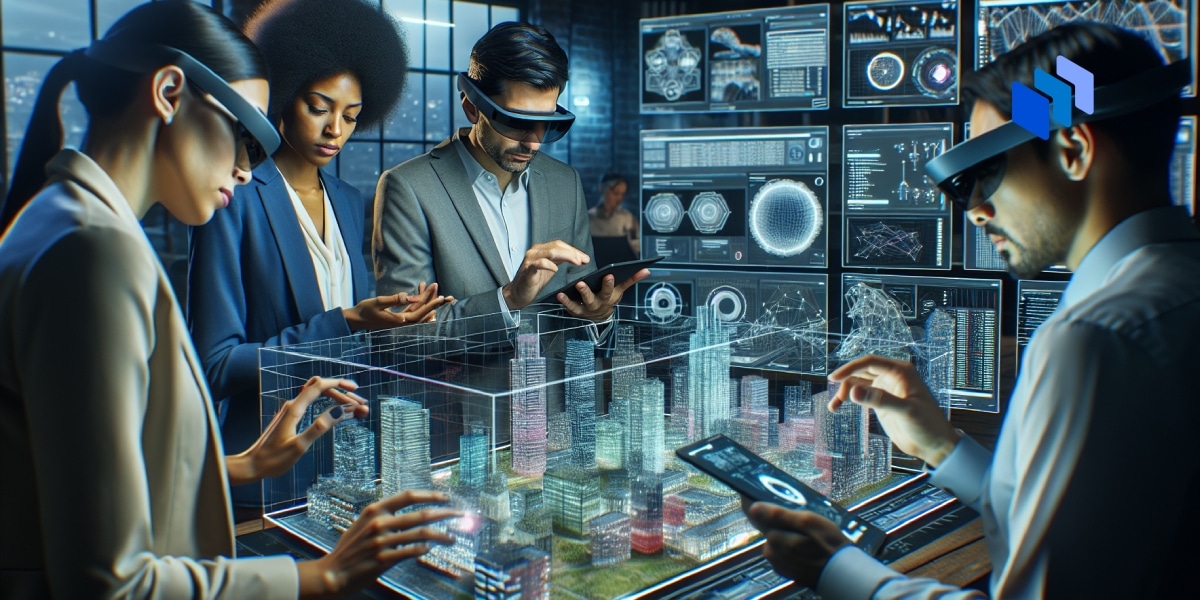
Spatial Project Management: Imagine a construction project where the architectural plans are no longer flat blueprints but a full-scale, interactive 3D model that the entire team can walk through. Engineers, architects, and clients can gather inside the virtual building, identify potential design clashes in real-time, and make annotations that are permanently pinned to specific locations within the model.
-
AR-Enhanced On-Site Assistance: A field technician repairing a complex piece of machinery can use AR glasses to see a digital overlay of the equipment. An expert from headquarters can see what the technician sees and draw arrows or highlight components directly in their field of view, guiding them through the repair step-by-step, drastically reducing errors and downtime.
B. Supercharging Training and Onboarding
Traditional training methods often struggle to bridge the gap between theory and practice. Spatial computing creates a “learn by doing” environment that is both safe and highly effective.
-
High-Risk Skill Simulation: Surgeons can practice complex procedures on virtual patients. Aircraft mechanics can learn to dismantle and reassemble a jet engine without the risk of causing millions in damage. These simulations can replicate rare fault scenarios, ensuring employees are prepared for any situation.
-
Interactive Onboarding: New employees can go through an immersive orientation, taking a virtual tour of company facilities, interacting with 3D models of products, and completing interactive modules that explain company processes. This creates a more engaging and memorable first-day experience compared to reading a static PDF manual.
-
Procedural Guidance in Context: For tasks that require adherence to strict protocols, such as in pharmaceuticals or manufacturing, AR can provide workers with real-time, step-by-step instructions overlaid directly onto their workspace. This ensures compliance, reduces training time for new procedures, and minimizes human error.
C. Accelerating Design, Prototyping, and Manufacturing
The design and manufacturing cycle is notoriously time-consuming and expensive, largely due to the need for physical prototypes. Spatial computing compresses this timeline dramatically.
-
Conceptual Design and Iteration: Designers and engineers can create and manipulate 3D models in a shared virtual space. They can stretch, reshape, and test the ergonomics of a product design in real-time, making collaborative decisions faster and with greater creative freedom.
-
Digital Twins: A Virtual Replica of the Physical World: A “digital twin” is a dynamic, virtual representation of a physical asset, process, or system. Using IoT data, the digital twin mirrors its physical counterpart in real-time. Engineers can use MR to see the digital twin overlaid on the actual machinery, allowing them to monitor performance, run simulations to predict failures, and plan maintenance with pinpoint accuracy without ever shutting down production.
-
Spatial Visualization of Data: Complex data sets, from financial markets to logistics networks, can be transformed from abstract spreadsheets into interactive 3D landscapes. A supply chain manager could “walk through” a visualization of their global logistics network, instantly identifying bottlenecks and understanding the ripple effects of disruptions in an intuitive way.
C. The Tangible Benefits: Why Businesses Are Investing
The applications are compelling, but the bottom-line benefits are what will drive widespread adoption. The shift to a spatial computing digital workplace offers a significant return on investment across several key metrics.
A. A Dramatic Surge in Productivity and Efficiency
By overlaying information directly into the context of a task, spatial computing eliminates the constant switching between screens and applications that fragments focus. Workers can complete complex procedures faster and with fewer errors when they have hands-free, visual guidance. The ability to collaborate on 3D models in real-time, regardless of location, slashes the time spent on design iterations and project reviews.
B. Unprecedented Levels of Collaboration and Engagement
Spatial computing fosters a sense of “presence” that video calls cannot replicate. The feeling of sharing a space with colleagues, even a virtual one, builds stronger team cohesion and trust. This is especially critical for sustaining company culture in a distributed workforce. Engaging, interactive training modules also lead to higher knowledge retention and a more skilled workforce.
C. Significant Reduction in Costs and Environmental Impact
The need for physical travel for meetings, site inspections, and training is substantially reduced. The cost of producing multiple physical prototypes is eliminated when designs can be perfected in a virtual space. Furthermore, by using digital twins for planning and simulation, companies can optimize their operations, reduce waste in materials and energy, and prevent costly equipment downtime through predictive maintenance.
D. Fostering a Culture of Innovation and Creativity
When teams are freed from the constraints of 2D interfaces and physical distance, creativity flourishes. The ability to rapidly prototype and interact with ideas in 3D space encourages experimentation. Brainstorming sessions in an immersive environment can lead to breakthrough ideas that would not have emerged in a traditional conference room setting.
D. Navigating the Challenges and Considerations
The path to a fully realized spatial computing workplace is not without its obstacles. A successful implementation requires careful planning and a clear-eyed view of the challenges.
A. The Technological Hurdles: Hardware and Connectivity
Current generation AR/VR headsets, while impressive, still face limitations in terms of battery life, comfort for all-day wear, display resolution, and field of view. Furthermore, processing complex 3D environments and streaming them seamlessly requires robust, low-latency connectivity, such as 5G or high-speed Wi-Fi 6E. The technology is evolving rapidly, but these are current barriers to mass adoption.
B. The Financial Investment and ROI Justification
The initial investment in hardware, software development, and systems integration can be significant. Businesses must develop a clear business case and identify specific use cases where spatial computing will deliver a measurable return on investment, whether through increased productivity, reduced errors, or lower travel costs. A phased rollout, starting with pilot programs in high-impact areas, is often the most prudent approach.
C. Data Security and Privacy in an Immersive World
A spatial computing environment generates and processes immense amounts of data, including highly sensitive biometric data (e.g., eye tracking, hand movements) and detailed information about a company’s physical operations. Securing this data from cyber threats is paramount. Furthermore, the always-on nature of cameras and sensors in the workplace raises complex questions about employee privacy that must be addressed through transparent policies and ethical guidelines.
D. User Adoption and Change Management
As with any major technological shift, user resistance is a potential barrier. Some employees may experience motion sickness or discomfort when using headsets. Others may be hesitant to adopt a completely new way of working. Comprehensive change management, including clear communication, robust technical support, and effective training, is essential to ensure a smooth transition and widespread buy-in.
E. The Future Trajectory: Where Do We Go From Here?
The spatial computing digital workplace is still in its nascent stages, but the trajectory is clear. We are moving towards a future where the digital and physical are inextricably linked.
In the coming years, we can expect hardware to become as lightweight and socially acceptable as a pair of everyday glasses. The user interface will evolve from hand controllers to gesture, gaze, and voice control, making interactions even more natural. Artificial Intelligence will be deeply integrated, acting as an intelligent assistant that can proactively surface relevant information and automate tasks within the spatial environment.
The concept of the “office” will be redefined. It will no longer be a fixed physical location but a dynamic, customizable layer of digital tools and spaces that can be accessed from anywhere. Work will become a activity defined by tasks and outcomes, not by a physical desk. Companies that begin to explore and experiment with spatial computing today will be the industry leaders of tomorrow, having built the foundational knowledge and infrastructure to leverage this transformative technology to its fullest potential.
Conclusion: The Inevitable Integration
The evolution of the digital workplace is a story of increasing integration. We moved from mainframes in separate rooms to personal computers on every desk, and then to connected mobile devices in our pockets. Spatial computing is the next, and perhaps final, step in this journey the step where the digital world seamlessly integrates into our physical reality. It promises to break down the final barriers between us and our tools, between our colleagues and our data. By making digital information spatial, contextual, and intuitive, it has the power to unlock human potential in ways we are only beginning to imagine. The future of work is not just remote or hybrid; it is spatial. And that future is closer than we think.