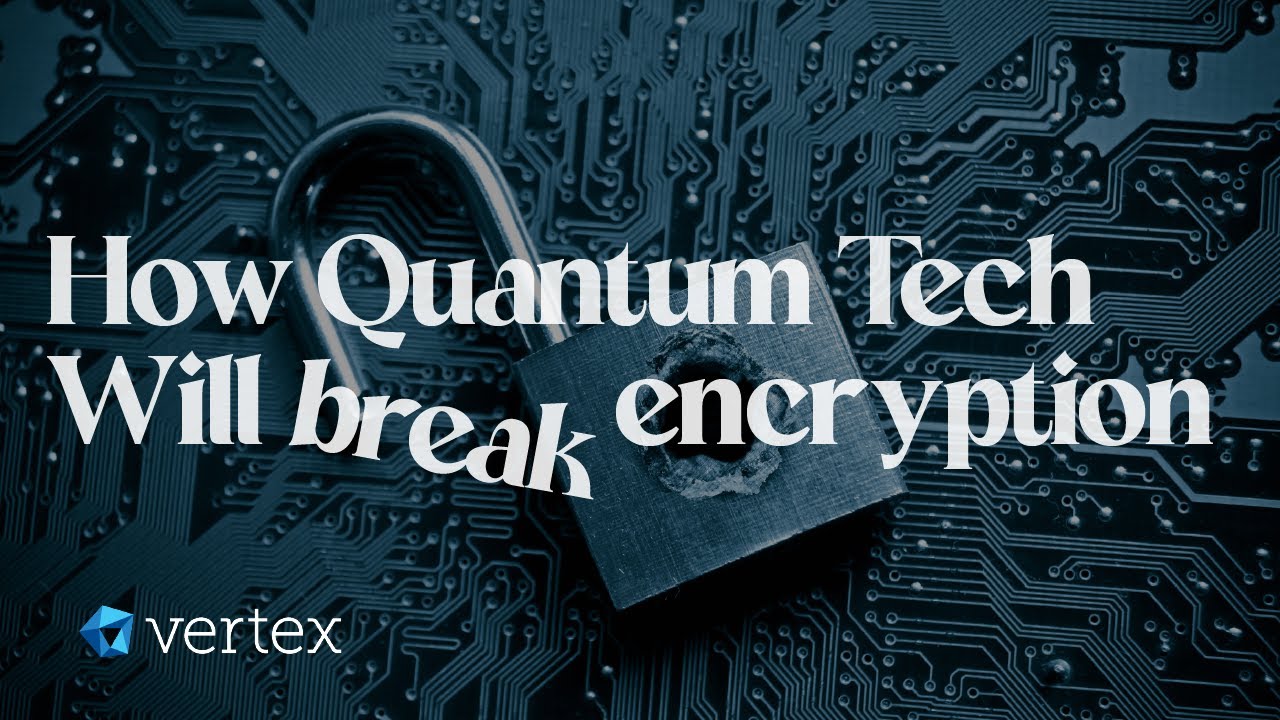
For decades, the bedrock of our digital security has been a simple, powerful concept: certain mathematical problems are so difficult that even the most powerful supercomputers would take billions of years to solve them. This principle secures our online banking, protects our private messages, and authenticates our identities on the web. But a technological tsunami is brewing on the horizon, one that promises to shatter this foundation and reshape the landscape of cybersecurity forever. This is the era of quantum computing, and its potential to break the encryption we rely on is the single most significant threat to digital privacy and global security in the 21st century.
To understand the gravity of this situation, we must first dismantle the myth and grasp the reality of quantum computing, delve into the specific vulnerabilities it exposes, and, most critically, explore the global race to build defenses that can withstand this unprecedented computational power.
A. Demystifying the Quantum Beast: How It Differs from Classical Computing
A classical computer, the device you’re using to read this, processes information in bits. A bit is a binary unit that can be either a 0 or a 1. Every app, website, and file is ultimately a vast, intricate sequence of these zeros and ones, processed through logic gates in a linear, step-by-step fashion. It’s powerful, but it’s also fundamentally limited.
A quantum computer operates on an entirely different set of rules the bizarre and counterintuitive laws of quantum mechanics. Instead of bits, it uses quantum bits, or qubits.
A. Superposition: Unlike a classical bit that is definitively 0 or 1, a qubit can exist in a state of superposition, meaning it is both 0 and 1 simultaneously. Think of it not as a simple switch, but as a sphere where any point on its surface represents a unique blend of 0 and 1.
B. Entanglement: This is a phenomenon Einstein famously called “spooky action at a distance.” Qubits can be entangled, meaning the state of one qubit is intrinsically linked to the state of another, no matter how far apart they are. Measuring one instantly reveals the state of the other. This creates a profound correlation that allows quantum computers to process information in a massively parallel way.
C. Quantum Interference: The states of qubits can be manipulated using quantum gates to amplify the probability of correct answers and cancel out the probability of wrong ones, guiding the computation toward the desired solution.
The combined power of these properties means that while adding a classical bit linearly increases processing power, adding a qubit exponentially increases the computational space. Two bits can represent one of four states (00, 01, 10, 11) at a time; two qubits in superposition can represent all four states simultaneously. With 300 perfectly functioning qubits, a quantum computer could, in theory, represent more states than there are atoms in the known universe. This parallelism is the source of its revolutionary potential and its profound threat to cryptography.
B. The Cryptographic Pillars at Risk: RSA and ECC Explained
Modern asymmetric encryption, also known as public-key cryptography, relies on “trapdoor functions”—problems that are easy to compute in one direction but excruciatingly difficult to reverse without a special key. The two most critical systems at risk are RSA and Elliptic Curve Cryptography (ECC).
A. The RSA (Rivest–Shamir–Adleman) Algorithm: This widespread algorithm, used for securing web traffic (HTTPS), email, and digital signatures, is based on the practical difficulty of factoring the product of two large prime numbers. For instance, if you multiply two prime numbers like 1,999 and 4,153 (which is 8,301,847), it’s trivial for a computer. However, given the number 8,301,847, finding its two prime factors is a computationally intensive task. For numbers with hundreds or thousands of digits, this problem is considered intractable for classical computers, securing our data for decades.
B. The ECC (Elliptic Curve Cryptography) Algorithm: A more modern and efficient alternative to RSA, ECC provides similar security with smaller key sizes. Its security rests on the “elliptic curve discrete logarithm problem.” In simple terms, it involves operations on points on a specific type of mathematical curve. It’s easy to perform an operation to move from point A to point B, but nearly impossible to deduce the path taken (the private key) if you only know points A and B (the public key). ECC is ubiquitous in mobile communications, cryptocurrency wallets (like Bitcoin and Ethereum), and government systems.
For classical computers, cracking a 2048-bit RSA key would take millions of years using the best-known algorithms. This is the fortress that has protected our digital lives. However, in 1994, a mathematician named Peter Shor developed an algorithm that would turn this fortress into a house of cards in the face of a sufficiently powerful quantum computer.
C. Shor’s Algorithm: The Quantum Sledgehammer
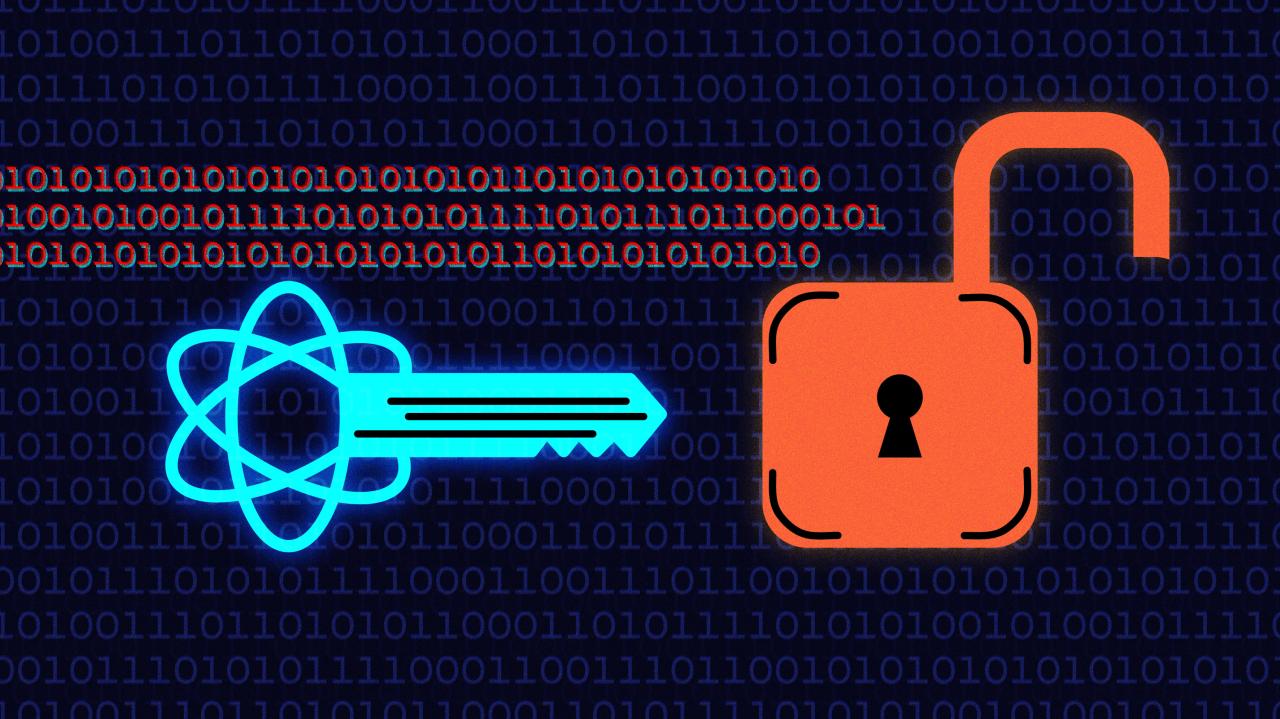
Shor’s Algorithm is a quantum algorithm specifically designed to solve the exact problems that RSA and ECC rely on: integer factorization and discrete logarithms. Here’s how it dismantles classical encryption:
A. The Quantum Period-Finding Core: Shor’s algorithm cleverly transforms the factoring problem into a problem of finding the “period” of a function. This period-finding task is perfectly suited for a quantum computer.
B. Leveraging Superposition and Interference: The quantum computer uses a register of qubits in superposition to evaluate the function for all possible inputs simultaneously. It then employs the Quantum Fourier Transform (QFT), a process that leverages quantum interference to pinpoint the period of the function from this massive superposition of states.
C. Exponential Speedup: While the best classical algorithms for factoring are “sub-exponential” in their time complexity, Shor’s algorithm solves the problem in polynomial time. This is the difference between a task taking longer than the age of the universe and a task taking a few hours or days. A large-scale, error-corrected quantum computer running Shor’s algorithm could break a 2048-bit RSA key in a matter of hours.
The implications are staggering. A nation-state or well-funded entity with access to such a machine could decrypt any intercepted internet communication that was secured with RSA or ECC, whether it’s a state secret, a financial transaction, or a private medical record. They could forge digital signatures, impersonate websites, and drain cryptocurrency wallets. The very fabric of digital trust would unravel.
D. Grover’s Algorithm and the Threat to Symmetric Encryption
While Shor’s algorithm is a direct, targeted attack on public-key cryptography, another quantum algorithm, Grover’s Algorithm, poses a different kind of threat to symmetric encryption.
Symmetric encryption, used in standards like AES (Advanced Encryption Standard), relies on a single shared key for both encryption and decryption. Its security is based on the sheer number of possible keys. A brute-force attack trying every possible key until the right one is found is the primary threat. For a 128-bit key, there are 2^128 possible combinations, a number so vast it’s considered secure against classical attacks.
Grover’s Algorithm provides a quadratic speedup for searching unstructured databases. In the context of cryptography, it can find the correct symmetric key by searching through all possibilities in roughly the square root of the time it would take a classical computer. To brute-force a 128-bit AES key, a classical computer would need to check ~2^128 possibilities. A quantum computer using Grover’s algorithm would only need ~2^64 checks.
While this is a significant reduction, it is not as catastrophic as Shor’s algorithm. The defense is straightforward: double the key size. AES-128, while weakened, can be replaced by AES-256. For a 256-bit key, Grover’s algorithm would still require 2^128 operations, which remains a physically infeasible task, even for a quantum computer. Therefore, symmetric cryptography is not doomed but will require an upgrade.
E. The Timeline: When Will The Quantum Break Happen?
This is the multi-billion-dollar question. The development of a “cryptographically relevant” quantum computer (CRQC) is not a matter of if but when. However, we are not there yet. The current state of quantum hardware is best described as the “Noisy Intermediate-Scale Quantum” (NISQ) era.
-
Qubit Quality Over Quantity: The challenge isn’t just building more qubits; it’s building high-quality qubits. Qubits are extremely fragile and susceptible to environmental interference, causing them to lose their quantum state (a process called decoherence) and introduce errors.
-
The Error Correction Hurdle: To run complex algorithms like Shor’s, we need millions of stable “logical qubits.” Today’s most advanced quantum processors have only a few hundred physical qubits. Achieving a single logical qubit requires bundling many error-prone physical qubits together in sophisticated error-correction codes. We are still years, likely decades, away from the fault-tolerant quantum computers needed to break RSA-2048.
Experts provide a wide range of estimates, from 10 to 30 years. However, the threat is already present today due to a dangerous strategy known as “Harvest Now, Decrypt Later.”
F. The “Harvest Now, Decrypt Later” Attack
This is a clear and present danger. Adversaries with long-term objectives such as foreign intelligence agencies are likely already intercepting and storing massive amounts of encrypted data traversing the internet. This data could include military secrets, intellectual property, and confidential government communications.
They are betting that within the next 10-20 years, they will acquire a quantum computer capable of decrypting this harvested data. The sensitive information they obtain today will still be valuable decades from now military plans, pharmaceutical formulas, and diplomatic cables have extremely long shelf-lives. This means that data requiring long-term confidentiality is already vulnerable.
G. The Defense: An Introduction to Post-Quantum Cryptography (PQC)
The global cryptographic community is not sitting idly by. The solution lies in Post-Quantum Cryptography (PQC), also known as quantum-resistant cryptography. These are new classical cryptographic algorithms designed to be secure against attacks from both classical and quantum computers.
Unlike quantum key distribution (QKD), which relies on physics to secure communication channels, PQC is a software-based solution that can be integrated into existing systems and protocols, making it more scalable and practical for global deployment.
The leading candidates for PQC standards, selected by the U.S. National Institute of Standards and Technology (NIST) after a multi-year competition, are based on mathematical problems that are believed to be hard for quantum computers to solve. The main families include:
A. Lattice-Based Cryptography: Based on the difficulty of finding the shortest vector in a high-dimensional lattice, even when given a “bad” basis for the lattice. This is a very versatile family and is a leading contender for general encryption and digital signatures.
B. Code-Based Cryptography: Relies on the difficulty of decoding a general linear code a problem that has been studied for decades and has resisted attacks from both classical and quantum algorithms. The McEliece cryptosystem is a famous example.
C. Multivariate Cryptography: Based on the difficulty of solving systems of multivariate polynomial equations over finite fields. This approach is primarily being considered for digital signatures.
D. Hash-Based Cryptography: Uses the security properties of cryptographic hash functions to create digital signatures. While not suitable for general encryption, it offers very robust and well-understood signature schemes like XMSS and LMS.
In 2022, NIST announced its first selection of algorithms for standardization, with CRYSTALS-Kyber for general encryption and CRYSTALS-Dilithium for digital signatures being among the primary choices. The migration to these new standards is the most critical cybersecurity project of our time.
H. The Massive Challenge of Migration and Implementation
Adopting PQC is not as simple as flipping a switch. It is a monumental task that will take years and cost billions of dollars.
A. Legacy System Integration: Countless embedded systems, from industrial controllers to medical devices, use hardware that cannot be easily updated. These “brownfield” environments represent a massive vulnerability.
B. Performance and Overhead: Some PQC algorithms have larger key sizes, signature sizes, or require more computational power than their classical predecessors. This can impact the performance of network bandwidth, storage, and battery-powered devices, requiring careful optimization.
C. Cryptographic Agility: Organizations must build “cryptographic agility” the ability to swiftly swap out cryptographic algorithms as threats evolve. This requires changes in software development practices, standards, and infrastructure.
D. The Global Coordination Problem: Every device, browser, server, and protocol on the internet needs to be updated. This requires unprecedented coordination between governments, industries, and standards bodies worldwide.
I. Conclusion: A Call to Action for the Quantum Age
The narrative that “quantum computing breaks encryption” is not a futuristic fantasy; it is a foreseeable event that demands immediate and sustained action. The quantum threat is unique because it has a known expiration date for our current security. The time to prepare is now, while the classical walls still stand.
The transition to a quantum-resistant world is arguably more challenging than the Y2K problem. It requires awareness, investment, and proactive strategy from every organization that handles sensitive data. The journey has begun, with NIST standards leading the way, but the real work the global implementation lies ahead. The goal is not just to survive the arrival of cryptographically relevant quantum computers, but to build a digital ecosystem that is resilient, agile, and secure for the next generation of technological revolutions. The quantum clock is ticking, and our response will define the security of the digital age for decades to come.